Network evidence at registration
A network observation can support a registration decision without proving that profile details are fabricated. Keep route and account evidence separately reviewable.
Summarize with AI
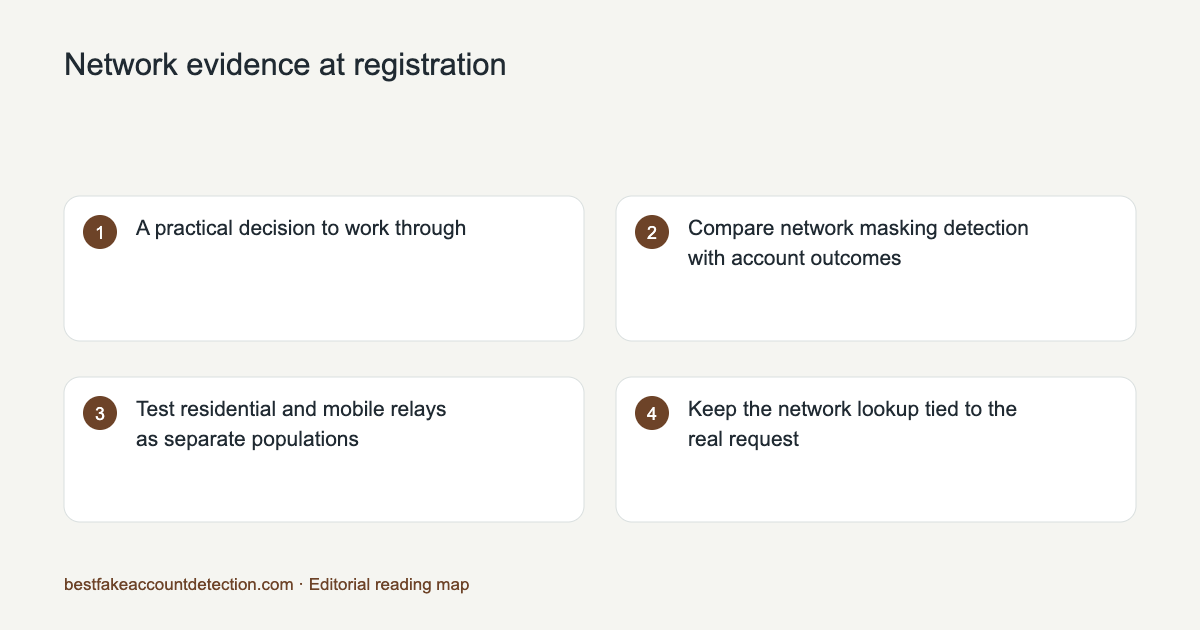
A practical decision to work through
A hypothetical gaming signup from a VPN can belong to a real new player, while a normal home connection can create repeated promotional accounts. Compare account/device history and the value being granted. Retain trusted IP provenance and freshness, and make unavailable results explicit. This lets the team distinguish a detector's coverage gap from a policy that incorrectly rejects every privacy user.
Compare network masking detection with account outcomes
A fake profile may use an ordinary route; a genuine user may prefer a VPN. MaxMind/IPQualityScore provide network evidence, while ShieldLabs, Castle and SEON add account/device context. Preserve freshness and missing responses. Relay geolocation describes the exit, as MaxMind explains. Evaluate categories alongside the actual signup purpose and later outcomes rather than rejecting every masked network.
Test residential and mobile relays as separate populations
Consumer and mobile relays can distribute registrations across ordinary-looking addresses. Add current network intelligence and device/account history rather than relying on hosting lists. Shared carrier addresses are a legitimate control. Test known routes and real users at equivalent times, reporting network classification and account abuse separately. An accurate relay flag cannot establish whether a person's profile details are fabricated.
Keep the network lookup tied to the real request
A registration backend should use the address from its trusted proxy boundary, not an arbitrary client header. Cloudflare documents relevant fields for its deployment. Protect secrets, validate inputs and bind lookup time to the signup. Handle cache freshness, timeouts and quotas visibly. Browser JavaScript and Python/backend calls must still pass through server eligibility and privilege controls.
Read the score definition before using a threshold
An address score can prioritize a registration review without proving identity. Read the provider's scale and fields instead of averaging IP, device and account scores. IPQualityScore and ShieldLabs outputs have different scope; ShieldLabs classifies 0–100 risk as Trusted/Suspicious/Dangerous. Test the response against legitimate activation and confirmed misuse, keeping a correction path for uncertain applicants.
Distinguish IP location, device location and travel
Profile country, IP exit and permissioned device coordinates can disagree legitimately. Keep source, accuracy and time; MDN defines coordinate accuracy and Apple explains Private Relay region behavior. Compare account history and timing. Incognia supplies native location/device risk and ShieldLabs includes spoofing/network signals. Regulatory eligibility needs suitable verification rather than a city-mismatch rule.
Read a privacy checker as a snapshot of exposed information
A privacy checker reports what that page observes, not whether profile details are true. Proxy6 is a snapshot of IP/browser exposure. Other services may have account/payment history and different collection. Change one authorized fixture setting at a time, avoid credentials in unknown forms and do not treat a pass badge as invisibility. Multilingual anonymity aliases receive English guidance here.
Sources
- Proxy official source · read
- Ipqs official source · read
- Shield official source · read
- Castle official source · read
- Seon official source · read
- Relay official source · read
- Fraudfoxpaper official source · read
- Rest official source · read
- Cache official source · read
- Logging official source · read
- Headers official source · read
- Oxylabs official source · read
- Brightdata official source · read
- Geo official source · read
- Incognia official source · read
- Fpprivacy official source · read
- Authorization official source · read
- Boost official source · read
- Proxy6 official source · read
Continue reading
- Fake profiles versus compromised accounts
- Evidence behind an account identity
- Account links roles and repeat benefits
- Fake account risk through marketplace commerce
- Measure genuine account activation
- Buy account verification and risk services
- Stop recurring bot accounts
- Fake accounts vs synthetic identities
- Fake account detection false positives
- Public checkers and vendor demos
- More research guides
FAQ
How does FraudFox relate to proxy use?
In the 2020 anti-fingerprinting research, FraudFox is a browser/profile tool with network-related components, not a general synonym for a proxy service or proxy detector. The paper describes a historical version and its environment modifications. Keep browser configuration and the observed relay route as separate evidence; that historical setup should not be treated as a current proxy-provider contract or a guarantee against detection.
Which mobile-proxy providers belong in an authorized data-access shortlist?
Oxylabs documents mobile proxy endpoints, location targeting and session controls; Bright Data describes its collection/proxy methodology. Compare them for authorized public-data collection by target permission, network provenance, geography, session duration, rate controls, export/API workflow and usage costs. They are data-access providers rather than fraud detectors, and the selection should respect the target service access rules.
How should a user approach bypass or evasion claims?
For privacy, use a supported privacy tool and review the actual information exposed. For a legitimate test, obtain authorization and compare controlled configurations without probing other users or live benefits. Respect the service access and entitlement rules. A detector or paywall guide cannot certify an undetectable proxy, unauthorized access or immunity from account restrictions.
What does the Proxy6 anonymity check establish?
Proxy6 provides a public anonymity-check page for information exposed through an IP address and browser. Its output is specific to that page, browser and observation time. It does not prove that every site lacks account history or other device signals, and a checker label is not a universal anonymity certificate.