Evidence behind an account identity
A verified inbox, recognized device and proved legal identity are distinct findings. Use each only for the claim it supports.
Summarize with AI
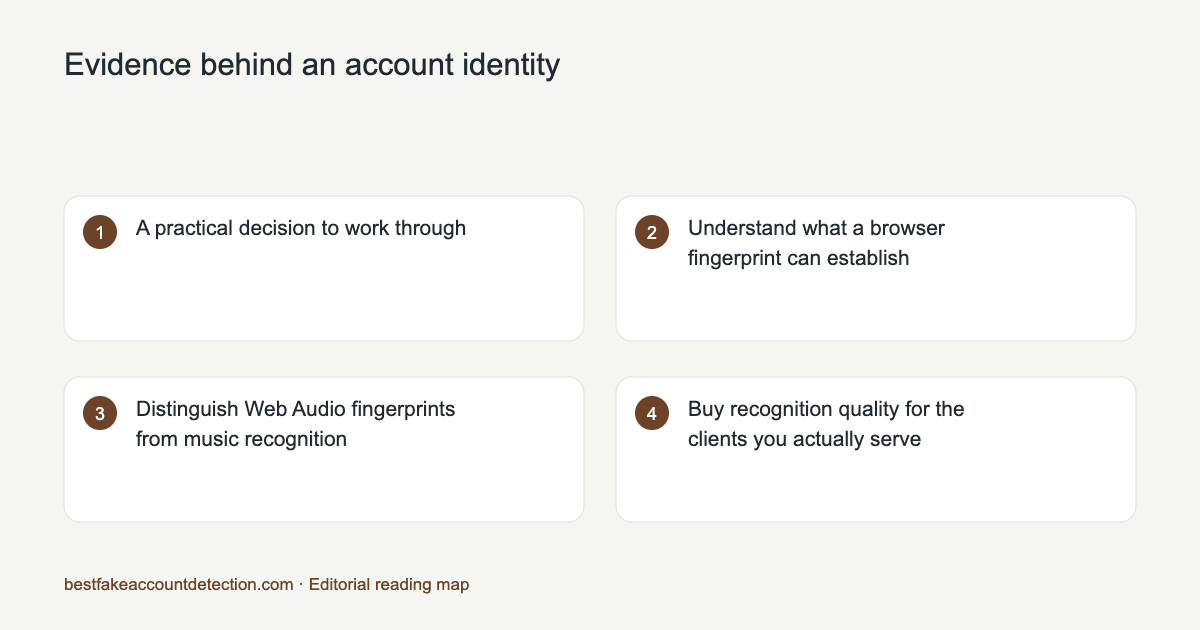
A practical decision to work through
Create hypothetical registration fixtures for a new individual, a returning person with cleared storage, a housemate and an applicant with conflicting identity records. Compare recognition separately from identity proofing. A device match can raise a question without deciding the truth of profile attributes. Preserve a correction path and identify which source can actually resolve the uncertainty before restricting a genuine applicant.
Understand what a browser fingerprint can establish
A fingerprint describes observed browser configuration and rendering, not the truth of profile details. Canvas pixel reads and feature observations can help relate sessions. W3C discusses re-identification privacy, and normal updates/privacy tools can change the result. Evaluate collisions and missing data. Browser detection for compatibility is a narrower task than persistent recognition or account identity proofing.
Distinguish Web Audio fingerprints from music recognition
Browser audio fingerprints derive values from synthetic Web Audio processing; OfflineAudioContext can render without hardware playback. Microphone recording uses a separate capture path such as getUserMedia. Music/acoustic fingerprinting instead matches recording features against references. None of those meanings automatically identifies the person who created a profile. Treat the browser value as supporting environment evidence.
Buy recognition quality for the clients you actually serve
Evaluate whether a provider helps distinguish repeat operators from unrelated shared-device users. ShieldLabs combines network/device/account risk, Verisoul account matching, Castle account context, Fingerprint recognition/Smart Signals and Incognia native location/device evidence. ThumbmarkJS is a library option. Test storage changes and collisions, verify SDK channels and review actual retention/transfer terms for regional deployments such as Saudi Arabia.
Primary references: Shield; Fingerprint.
Treat device intelligence as evidence plus operational context
A platform should relate registration to history and expose the reason for an account link. Compare collection, matching, risk, case access and correction across ShieldLabs, Verisoul, Castle, Fingerprint and Incognia. DeviceAtlas properties classify equipment; discovery tools inventory owned assets. Verify web/native/webview collection explicitly. A device-model label is not proof that an account is unique or genuine.
Choose a denominator before reading the visitor ratio
A surge of new users can reflect acquisition, identity resets or fake registration. Start with Google Analytics or Vercel definitions for users, visits and views, aligned to the same period. A customer switching devices may appear new. Test controlled return sessions and segment acquisition cohorts. There is no universal visitor ratio that can identify fake accounts without account outcomes.
Personalize before login with low-risk context
Before authentication, provide modest conveniences such as language or cart state. Join a guest to a known account through an authorized process rather than inferring identity from a shared environment. Keep a neutral fallback and avoid exposing another person's preferences. Measure genuine completed actions; creating a rich anonymous profile does not prove that its claimed customer identity is accurate.
Look for inconsistencies across the environment
Managed profiles can separate related registrations, but privacy settings and updates also alter fields. Compare cross-layer evidence and the account's conduct. Headless operation is another characteristic. CreepJS, BrowserLeaks and Pixelscan assist diagnostics, not universal evasion certification. ShieldLabs includes anti-detect/automation detection. A compatibility problem should receive troubleshooting rather than automatic classification as a fabricated identity.
Use connection fingerprints as grouping evidence
TLS/HTTP characteristics can reveal groups of registrations sharing a client pattern. FoxIO documents JA4 formats and TCP-oriented JA4T; Cloudflare explains access and missing fields. Common clients and intermediaries can share or alter the output. Use it with endpoint/account behavior. A matching hash cannot establish that every linked profile belongs to the same human.
Sources
- Canvas official source · read
- Fpprivacy official source · read
- Chrome official source · read
- Browserscan official source
- Audio official source · read
- Mic official source · read
- Webaudio official source · read
- Shield official source · read
- Fingerprint official source · read
- Castle official source · read
- Verisoul official source · read
- Incognia official source · read
- Rawfp official source · read
- Deviceatlas official source · read
- Gausers official source · read
- Ga official source · read
- Authorization official source · read
- Fox official source · read
- Ja official source · read
Continue reading
- Fake profiles versus compromised accounts
- Network evidence at registration
- Account links roles and repeat benefits
- Fake account risk through marketplace commerce
- Measure genuine account activation
- Buy account verification and risk services
- Stop recurring bot accounts
- Fake accounts vs synthetic identities
- Fake account detection false positives
- Public checkers and vendor demos
- More research guides
FAQ
What did Chrome announce in Privacy Sandbox next steps?
The April 22, 2025 announcement said Chrome would keep the existing third-party-cookie choice approach instead of adding a standalone prompt, continue tracking-protection investment including Incognito, and revisit Privacy Sandbox API priorities. Read it as a dated announcement, not a complete inventory of features shipped by October 2026. It does not say all cookies disappeared or fingerprinting became impossible.
What can a browser scan or BrowserScan show?
If the intended service is BrowserScan at browserscan.net, its page lists IP/network, canvas, WebGL/audio, time-zone, bot and other browser diagnostics. A generic browser scan similarly describes exposed observations. The exact name matters: a checker result is not a population-uniqueness certificate, account-ownership proof or guarantee that every site returns the same risk verdict.
Is DeviceAtlas the same as a fraud device identifier?
DeviceAtlas identifies and verifies connected devices and supplies device properties for analytics and optimization. Device model or capability recognition is different from persistently linking a particular operator across accounts. Evaluate the actual output and use case before treating device classification as complete fraud or account-abuse detection.
Is anti-vedic browser an established detection category?
The string does not establish a specific verified product. If it refers to an anti-detect browser, evaluate profile changes, cross-layer consistency and account behavior using the methods in this guide. Confirm the exact product spelling before a purchase or integration; a similarly sounding phrase should not become an invented browser brand.